
The decision by the Reserve Bank of India to introduce a unified regulatory framework on connected lending for all the regulated entities (RE) is expected to reduce the influence of business conglomerates in the Indian lending space, said bankers and experts. "Connected lending pertains to lending to related parties within the same business group. "While the RBI might appear more agreeable to allowing business conglomerates to own banking licenses, it deems it crucial to bolster regulations that would prevent conglomerate-owned banks from gaming the system," said Shivaji Thapliyal, head of research and lead analyst, YES Securities.

Benchmark BSE Sensex rose by 156 points while the Nifty closed above the 17,300 level on Thursday after gains in metal, IT and capital goods shares amid foreign capital inflows. The 30-share BSE benchmark gained 156.63 points or 0.27 per cent to settle at 58,222.10. During the day, it jumped 513.29 points or 0.88 per cent to 58,578.76.

'The reason being we cannot let premiums go beyond a certain point.'

The rupee on Tuesday recovered from its all-time intra day low of 77.79 to close higher by 7 paise on a stellar rally in domestic stock markets. After opening lower at 77.67, the local unit plunged further to its all-time intra-day low of 77.79 due to a spike in crude oil prices and disappointing macroeconomic data. However, a strong rally in domestic equities helped the rupee rebound and close at 77.48 (provisional), showing net gains of 7 paise over the last close of 77.55. The forex market was closed on Monday on account of Buddha Purnima.

Public-sector enterprise stocks have seen a good run thus far in 2023-24 (FY24), with the S&P BSE PSU Index surging by over 26 per cent during the period, compared to an 11 per cent increase in the benchmark S&P BSE Sensex.

The market capitalisation of BSE-listed companies jumped to a record high of Rs 2,40,04,664.28 crore on Tuesday, driven by a rally in stocks that also saw the benchmark Sensex touching its lifetime peak of 53,887.98 points. Rallying for the second consecutive day on Tuesday, the 30-share BSE index closed at a fresh closing peak of 53,823.36 points, a jump of 872.73 points or 1.65 per cent. During the day, it zoomed 937.35 points to 53,887.98 points.
.jpg)
As per the latest data compiled by market regulator Securities and Exchange Board of Indiabi, the net investments by Foreign Institutional Investors into Indian equity markets stood at Rs 51,433 crore (Rs 514.33 billion) this year so far, while the same for debt markets was at Rs 52,115 crore (Rs 521.15 billion) taking the total to Rs 1,03,548 crore ($17 billion).

The pharmaceuticals sector is expected to post a revenue growth of around 13.5 per cent and a net profit growth of 30.3 per cent for the third quarter of 2023-24 (FY24), riding on the approval for niche drugs in the US market, fall in raw material prices and correction in shipping rates. In the healthcare segment, hospitals are expected to post revenue growth of 13 per cent during the coverage, while net profit growth would be around 37 per cent, ICICI Securities said in a note. However, the performance may not be comparable on a sequential basis due to the offset of the festive season in Q3FY24, the analysts noted.
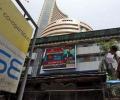
As many as 267 of 453 companies from the BSE500 index are trading above their consensus price targets, according to the data compiled by Bloomberg. Not all companies in the BSE500 index are tracked by analysts.

The rupee depreciated further by 13 paise to hit a new life-time closing low of 82.30 against the US dollar on Friday as a firm American currency and risk-averse sentiment among investors weighed on the local unit. Moreover, a negative trend in domestic equities and elevated crude oil prices sapped investor appetite, forex traders said. At the interbank foreign exchange market, the local currency opened at 82.19, then fell further to 82.43. It finally settled at an all-time low of 82.30 against the American currency, registering a decline of 13 paise over its previous close.

However, investors have turned cautious over the likelihood of Britain leaving the European Union.

Not just from the likes of Alibaba and Didi Chuxing, Indian startups saw a surge in Chinese funding from financial investors in 2019. This is a seven-fold jump from $459 million in 2016.

Domestic mutual funds (MFs) and foreign portfolio investors (FPIs) have been net buyers of stocks in August. Domestic fund houses have continued to invest in stocks, propelled by the success of various new fund offers (NFOs) and strong flows into equity funds. MFs had purchased stocks worth more than Rs 8,300 crore until August 23, according to the data provided on the Securities and Exchange Board of India (Sebi) website. Jimmy Patel, MD and CEO at Quantum AMC, says: "The surge in equity investments by MFs is because of two key reasons. One, equity NFOs are getting a strong response from investors, and fund houses need to deploy that money in the markets.


The move to demerge the hotel business into a separate entity by ITC has brought back focus on hotel stocks, which have already seen a good run thus far in fiscal 2023-24 (FY24). Analysts believe there could be more gains in store over the next one year for the stocks in this sector, but suggest investors put in money on a correction only from a long-term perspective. Hotel stocks, according to A K Prabhakar, head of research at IDBI Capital, have seen a good run as travel picked up post Covid in India. Not only have the room rents increased, the occupancy, too, has surged.

Dr Murthy, 43, a former United States Surgeon General, along with two other co-chairs -- Dr David Kessler and Dr Marcella Nunez-Smith -- would lead a team of leading public health experts who will advise Biden and Vice President-elect Kamala Harris on the deadly virus.

Dr Reddy's was the top gainer in the Sensex pack, rising over 3 per cent, followed by PowerGrid, TCS, HCL Tech, Infosys and Reliance Industries. On the other hand, L&T, IndusInd Bank, Bajaj Finserv and Bharti Airtel were among the laggards.

Despite the possibility of the economy bottoming out, the investment cycle could remain weak for another couple of years and earnings downgrades should continue.

The rise of the mall in India, at a time when many in the United States are becoming debt-ridden white elephants.

Axis Bank was the top gainer in the Sensex pack, surging around 5 per cent, followed by HDFC twins, ICICI Bank, Bajaj Finance and SBI. NSE Nifty zoomed 274.20 points to end at 14,982.

Gold as well as crude oil prices surged, with the latter even crossing the $103 per barrel mark. The domestic stock market opened deep in the negative territory, tumbling over 1,700 points and eroding investors' wealth by more than Rs 8 lakh crore in less than an hour of start of trade on Thursday.

Over the past year, the National Stock Exchange Nifty FMCG Index, which tracks the market capitalisation of the top 15 companies in the fast-moving consumer goods (FMCG) sector, has surged by 17.3 per cent. In contrast, the Nifty50, a broader market index, has witnessed an 8.8 per cent increase during the same period. The FMCG stocks have also been rally leaders in the current calendar year.

'Auto, pharma, and industrials have delivered well in the recent quarter, while businesses like quick-service restaurants, consumer staples, and durables have underperformed in volume growth.'

M&M was the top loser in the Sensex pack, shedding over 2 per cent, followed by Dr Reddy's Bharti Airtel, Tech Mahindra, HUL, ICICI Bank and Infosys. NSE Nifty dropped 64.80 points to 14,341.35.

The year-to-date returns are 13.33 per cent for Indian funds, compared to 11.66 per cent for emerging market funds overall.

IndusInd Bank was the top gainer in the Sensex pack, surging around 5 per cent, followed by Bharti Airtel, ICICI Bank, Axis Bank, PowerGrid, Tata Steel and HDFC Bank.

In 2012, private equity investments touched $7.5 billion.

PowerGrid was the top gainer in the Sensex pack, rising around 4 per cent, followed by ITC, Bajaj Finance, Infosys, NTPC and Tech Mahindra. NSE Nifty advanced 117.15 points to 17,072.60.

Gold prices are struggling and are down 18 per cent from their March highs. But stock prices have fallen even more. As a result, the precious metal has begun to outperform equities - both in the domestic market and international markets. Gold prices are up 2.6 per cent in the domestic market in the current calendar year (CY22) so far, according to the World Gold Council (WGC), compared to a 1.7 per cent decline in the Sensex year-to-date (YTD).

Asset Management Companies (AMCs) demonstrated improved business metrics in the first quarter ended June 2023 (Q1FY24), but a sharp run-up in stocks leaves little room for further upside in the immediate term, say analysts. During this quarter, HDFC AMC reported a 10 per cent year-on-year (YoY) rise in revenue from operations at Rs 575 crore. Nippon India's revenue from operations went up 12 per cent to Rs 354 crore.

Rise in crude oil price and rally in global equities aided the sentiment

The BSE SmallCap index gained 106 per cent in the one year ended May 12, 2021.

HCL Tech was the top gainer in the Sensex pack, rising over 4 per cent, followed by HDFC Bank, Infosys, NTPC, Nestle India, TCS and HUL. NSE Nifty surged 337.80 points to 14,845.10.

Top losers in the Sensex pack included M&M, SBI, Yes Bank, Asian Paints, HDFC, Tata Steel and L&T, shedding up to 2.55 per cent. The broader NSE Nifty settled 79.80 points, or 0.72 per cent, down at 10,996.10.

Morgan Stanley has increased the target prices of certain information technology (IT) stocks by as much as 29 per cent, anticipating an improvement in earnings in the near future. Within the IT and engineering research and development (ER&D) services sector, it is now more optimistic about growth and margin estimates for 2024-25 (FY25).

Foreign investment in India's start-ups has plummeted 72 per cent to $4.58 billion so far, from $16.2 billion during the same period last year.

At an aggregate level, the late ace investor's portfolio that was valued at Rs 32,445 crore as on March 31, 2023 is now worth Rs 35,979 crore.

Foreign investors have pumped in over Rs 1 lakh crore in the Indian securities market since Narendra Modi was announced as the prime ministerial candidate by Bhartiya Janta Party (BJP) in September last year.
Bulls of the Dalal Street once again managed to breach the 12,000-mark on Thursday, but the latest drive to this once-beaten milestone had less of foreign support that the Indian equity market has been getting through FII inflows.

Dealers attributed the rupee's fall to increased demand for the US currency from importers.
